
Escalators are one of the most used pieces of public infrastructure in the UAE. Every day, thousands of people ride escalators inside malls, metro stations, airports, hospitals, and commercial buildings across Dubai, Abu Dhabi, and Sharjah.
Most escalator accidents are preventable. Escalator accident prevention starts with awareness – over 90% of escalator-related injuries occur because of user behavior, not mechanical failure.
These escalator usage safety tips apply to everyone – daily commuters, shoppers, tourists, and facility managers across the UAE. Public space vertical mobility safety depends on every user making the right choice every single time.
Moving walkway safety tips follow the same principles as escalator safety – hold the handrail, stand clear of edges, and avoid distractions at all times.
How Do Escalators Actually Work?
An escalator is a motorized loop of steps driven by a chain system connected to a 5–15 kW electric motor. Understanding escalator hazards and risks starts with knowing the components most likely to cause injury.
Basic Components of an Escalator
Comb plates
The yellow-ridged metal panels at the top and bottom where steps appear and disappear – the most common entrapment zone.
Step gap edges
The 6 mm gaps between each step and the side skirt panel.
Handrails
Moving rubber belts running at step speed – releasing them removes your only balance point.
Escalators in UAE public buildings follow EN115:2017, governing step dimensions (400 mm minimum width), handrail speed tolerance (0–2%), and comb plate load capacity (1,100 N).
Why Escalator Safety Awareness Matters
A single escalator inside Dubai Mall can carry 30,000 passengers per day (Schindler Group, 2022). Escalator rules in malls and public spaces are based on real incident data – ignoring them increases fall, entrapment, and collision risk for every nearby rider.
What Are the General Escalator Safety Tips for Everyday Users?
Safe riding takes only a few seconds of preparation. Following escalator usage safety tips consistently is what separates a safe ride from a dangerous one.
Always Hold the Handrail
Grip the handrail the moment you step on – it moves at step speed and absorbs any sudden stop or passenger contact. Releasing it mid-ride increases fall risk by 58% in crowded conditions (National Safety Council, 2022).
Stand Properly on the Escalator
Stand in the centre of the step with both feet. Feet within 50 mm of the step edge risk comb plate entrapment at the landing zone – the yellow border markings indicate the safe standing area per EN115:2017 Article 5.4.
Pay Attention While Boarding and Exiting
Step on smoothly without hesitating and watch the step movement before placing your foot. At the exit, move immediately clear of the landing area – pausing creates pile-ups and collision risk for every passenger behind you.
Avoid Distractions While Using Escalators
Phone distraction reduces hazard awareness by 70% in high-traffic environments (National Safety Council, 2022). Dubai Metro Bylaw No. 5/2019 prohibits phone use while boarding or exiting escalators.
How to Keep Children Safe on Escalators?
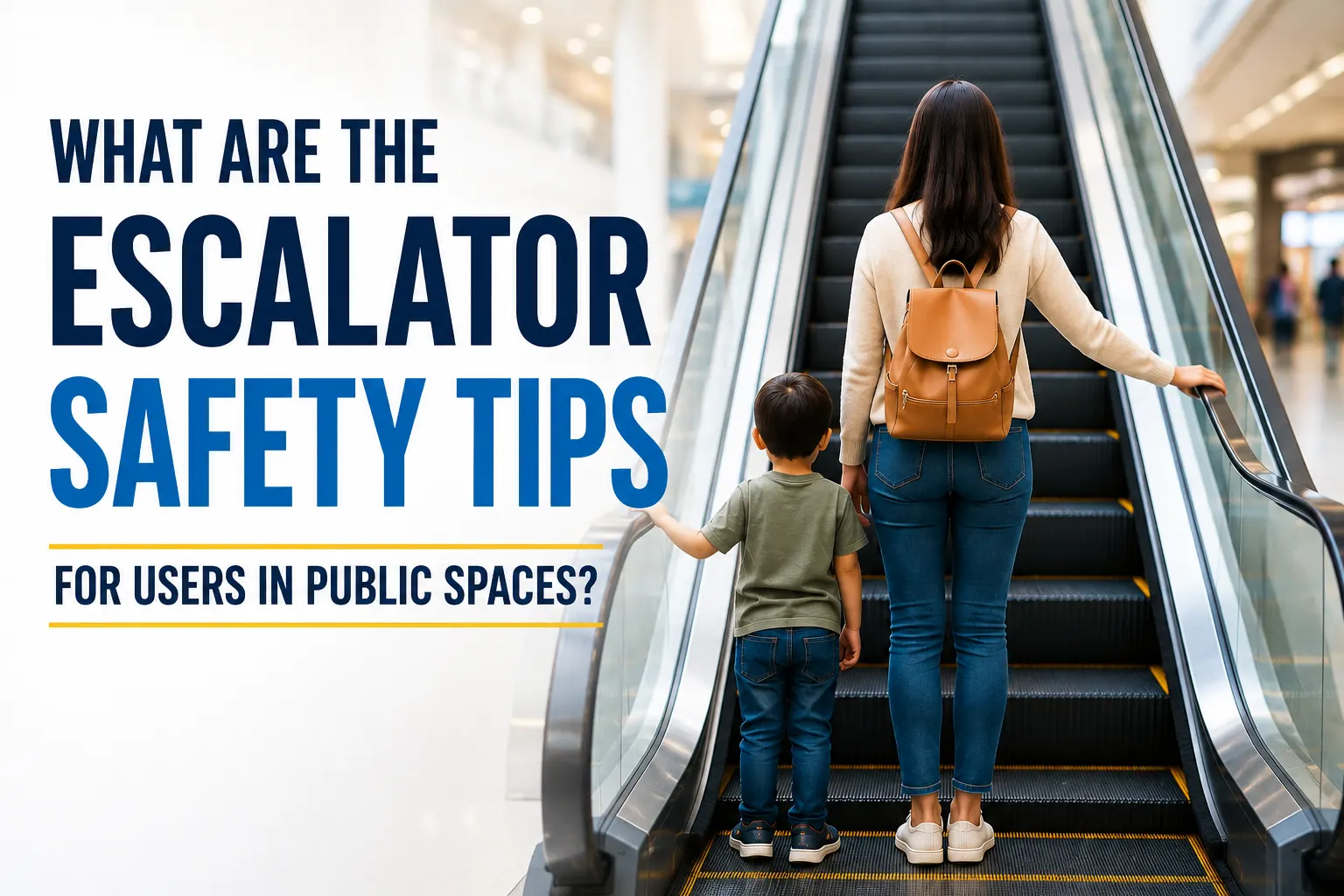
Escalator safety for children is one of the most critical areas of public safety in the UAE. Children face higher entrapment risk than adults due to smaller shoe sizes, loose clothing, and unpredictable movement near step edges.
Always Supervise Young Children
Children under 5 must be carried by an adult at all times. Dubai Municipality Public Safety Circular No. 12/2021 requires physical hand contact between adult and child from boarding to exit on all public escalators.
Hold Children’s Hands While Riding
Hold your child’s hand throughout the full ride without exception. Keep children standing safely in the middle of the step and facing the direction of travel. Avoid sitting, leaning, or standing near the sides of the escalator.
Keep Shoes, Toys, and Loose Clothing Away from Escalator Edges
Crocs, flip-flops, and rubber-soled sandals are the most common cause of foot entrapment in children on escalators (Elevator World, 2021). Scarves, abayas, and drawstring cords must be gathered close to the body – trailing fabric within 100 mm of the step surface can be drawn into the comb plate in under 0.3 seconds.
What Are the Escalator Safety Tips for Elderly and Mobility-Impaired Individuals?
Escalator safety for elderly users requires extra planning – limited mobility, slower reaction time, and balance challenges make escalators significantly more risky for this group. Knowing when to use an elevator instead is as important as knowing how to ride safely.
Use Handrails for Stability
Hold the handrail before stepping onto the escalator to help maintain balance as it starts moving. Maintain the grip until both feet are fully clear of the exit comb plate.
Take Extra Care While Boarding and Exiting
The boarding and exit zones are the most hazardous areas for elderly riders. Allow extra time, take one deliberate step at a time, and avoid peak hours – Dubai Metro stations carry over 12,000 passengers per hour between 8:00-9:30 AM and 5:30-7:00 PM.
Choose Elevators When Necessary
Wheelchairs, walkers, strollers, and mobility aids must never be taken on escalators. UAE Federal Law No. 29/2006 requires elevator access in all public buildings – Otis, Kone, and Schindler all provide companion elevator systems in their standard UAE installation packages.
How Should You Carry Luggage and Personal Items on Escalators?
Carrying bags or luggage on an escalator is safe only when items are held firmly and kept away from step edges. Large or bulky items must always go on the elevator – improper luggage handling is a direct escalator accident prevention failure many riders overlook.
Keep Bags and Luggage Secure
Hold bags firmly in front of the body – a bag placed loosely beside you can shift, slide, or trip other passengers. Backpacks must be removed and held by hand – a rear-mounted backpack shifts your centre of gravity backward by 80-120 mm, increasing fall risk on a moving incline.
Avoid Large or Bulky Items on Escalators
Large suitcases and shopping trolleys belong on elevators, not escalators. A 20 kg suitcase on an escalator step creates a 0.4 G instability force at the exit comb plate (ThyssenKrupp Elevator, Technical Safety Bulletin 2021).
Secure Loose Clothing and Accessories
Lanyards, long necklaces, and drawstring bags carried loosely near the step surface carry the same entrapment risk as trailing clothing. Gather all loose fabric and accessories close to the body before stepping on.
What Are the Most Common Escalator Mistakes to Avoid?
Most escalator injuries in public spaces come from a small set of repeated behaviors. Escalator safety rules in UAE malls and metro stations are based on real incident data – not guesswork.
- Standing near step edges – increases comb plate entrapment risk by 3x versus centre standing (Otis Safety Report, 2022)
- Running or walking fast – step height (200–210 mm per EN115:2017) is not designed for speed; falls from running cause 22% of escalator injuries
- Blocking exit zones – the exit clearance zone must stay free for at least 2.5 metres
- Carrying prams or strollers – strollers tip at exit comb plates due to front wheel drop into the comb gap
- Facing backward – removes visual awareness of the exit zone entirely
- Using mobile phones while riding – classified as a safety violation under Dubai Metro Bylaw No. 5/2019
- Ignoring posted signage – EN115:2017 Article 5.6 requires safety signs at every entry point; they encode real incident data
What Safety Features Do Public Escalators Have?
Modern escalators in UAE public buildings come with several built-in safety systems. Understanding these features is a core part of escalator safety guidelines for users and building managers alike.
| Safety Feature | Purpose | Responsible Party |
| Emergency Stop Button | Halts escalator immediately | User / Facility Staff |
| Comb Plate Guards | Prevents entrapment | Building Owner / Maintenance |
| Smart IoT Sensors | Detects faults in real time | Building Owner / Supplier |
| Anti-Slip Step Tread | Reduces slip risk | Escalator Manufacturer |
| Safety Signage | Guides correct user behavior | Building Owner |
Emergency Stop Buttons and Escalator Emergency Safety
Emergency stop buttons are positioned at the top and bottom of every escalator per EN115:2017 Article 5.12.3 – pressing one halts step movement within 1.5 seconds. Use it only for genuine emergencies; unnecessary activation causes sudden stops that can injure other passengers.
Routine Escalator Maintenance and Safety Standards
Escalator maintenance safety in the UAE is governed by EN115:2017 and the UAE Fire and Life Safety Code of Practice (2018 Edition). Each service cycle must cover comb plate alignment (±1 mm tolerance), step chain elongation (maximum 2% stretch), handrail integrity, and emergency stop function — with a minimum of two professional inspections per year.
Smart Escalator Systems
Smart escalator systems deployed in Dubai Mall and Yas Mall use Schindler PORT Technology and Otis ONE IoT sensors to monitor step alignment and vibration in real time. These systems alert facility teams before a fault becomes a public safety hazard.
Compliance with International Safety Standards
All escalators in UAE public spaces must comply with EN115:2017 and the UAE Fire and Life Safety Code of Practice (2018 Edition). Building owners are legally responsible for maintaining this compliance at all times.
What Are the Escalator Emergency Safety Steps You Should Follow?
Escalator emergency safety requires calm, fast action – panic causes secondary injuries more often than the initial event itself. Knowing what to do in advance reduces response time when it matters most.
What to Do If an Escalator Suddenly Stops
Keep holding the handrail – the steps remain fixed when the motor stops, making them safe to walk on. Move toward the nearest exit without rushing and report the stoppage to facility staff immediately.
Reporting Unusual Sounds or Malfunctions
Grinding sounds, jerking movement, or visible gaps between steps are EN115:2017 Article 7 shutdown criteria. Report to facility staff immediately and do not re-board until the unit has been inspected.
Handling Escalator Accidents Safely
Press the nearest emergency stop button immediately if someone falls – do not attempt to assist while steps are still moving. Once stopped, help the person exit the steps and call for medical assistance.
What Are the Responsibilities of Building Owners in Escalator Safety?
Building owners carry direct legal responsibility for escalator maintenance safety under EN115:2017 and Dubai Municipality Building Safety Standards, Section 14. Meeting that responsibility protects both users and the business from liability.
Installing High-Quality Escalator Systems
Certified equipment from Otis, Kone, Schindler, or ThyssenKrupp reduces breakdown frequency significantly. Smart escalator systems with built-in IoT monitoring give facility managers real-time visibility over equipment performance around the clock.
Conducting Regular Escalator Maintenance
Preventive servicing at fixed intervals is mandatory – missed cycles cause gradual wear that only becomes visible when a fault occurs. High-traffic UAE facilities require quarterly inspections covering comb plate alignment, step chain elongation, handrail integrity, and emergency stop function per EN115:2017 Article 5.5.
Providing Clear Safety Signage
Bilingual Arabic and English signs at every escalator entry point are mandatory under UAE Building Code Chapter 8.4. Signs must cover prohibited items and emergency stop button location – essential given the diverse population across UAE public spaces.
Training Facility Staff for Emergency Response
All facility staff must be trained on emergency stop operation, passenger flow management during faults, and escalator evacuation procedures. This is a non-negotiable requirement under Dubai Municipality Building Safety Standards, Section 14.
How Is Escalator Safety in Public Spaces Evolving in 2026?
Escalator safety technology is advancing rapidly across UAE public infrastructure. Smart cities like Dubai are integrating data-driven systems that improve escalator safety in public spaces at scale.
Smart Escalator Systems and Passenger Detection
Dubai Metro’s newest stations use LiDAR sensors to count passengers per step in real time, automatically reducing escalator speed from 0.65 m/s to 0.5 m/s when step occupancy exceeds safe thresholds. Schindler MAX and Otis ONE – deployed across UAE commercial buildings since 2024 – predict component failures 72 hours in advance from 300+ sensor data points per unit.
Anti-Slip and Enhanced Step Technologies
New step designs use textured surfaces and higher-grip materials that reduce slip risk for both dry and wet footwear. These are particularly valuable in UAE environments where footwear varies widely – from formal shoes to open sandals.
Energy-Efficient and Sustainable Escalator Solutions
Variable-speed drives in Kone EcoMod and ThyssenKrupp Synergy models reduce energy consumption by 30-40% during low-traffic periods under UAE Green Building Regulations (Estidama, 2025 update). These innovations are redefining escalator maintenance safety standards for commercial and public buildings across the UAE.
Escalator safety is simple when users know what to do. Hold the handrail. Stand in the centre. Watch your children. Use elevators for strollers and heavy luggage. Report anything that looks or sounds wrong.
Public spaces across the UAE – from Dubai malls to Abu Dhabi metro stations – handle millions of escalator rides every day. A small habit change from every user, and a consistent maintenance schedule from every building owner, can prevent the majority of escalator accidents before they happen.
Escalator safety is not just a rule on a sign. It is a shared responsibility between users, facility managers, and the companies that install and maintain these systems.