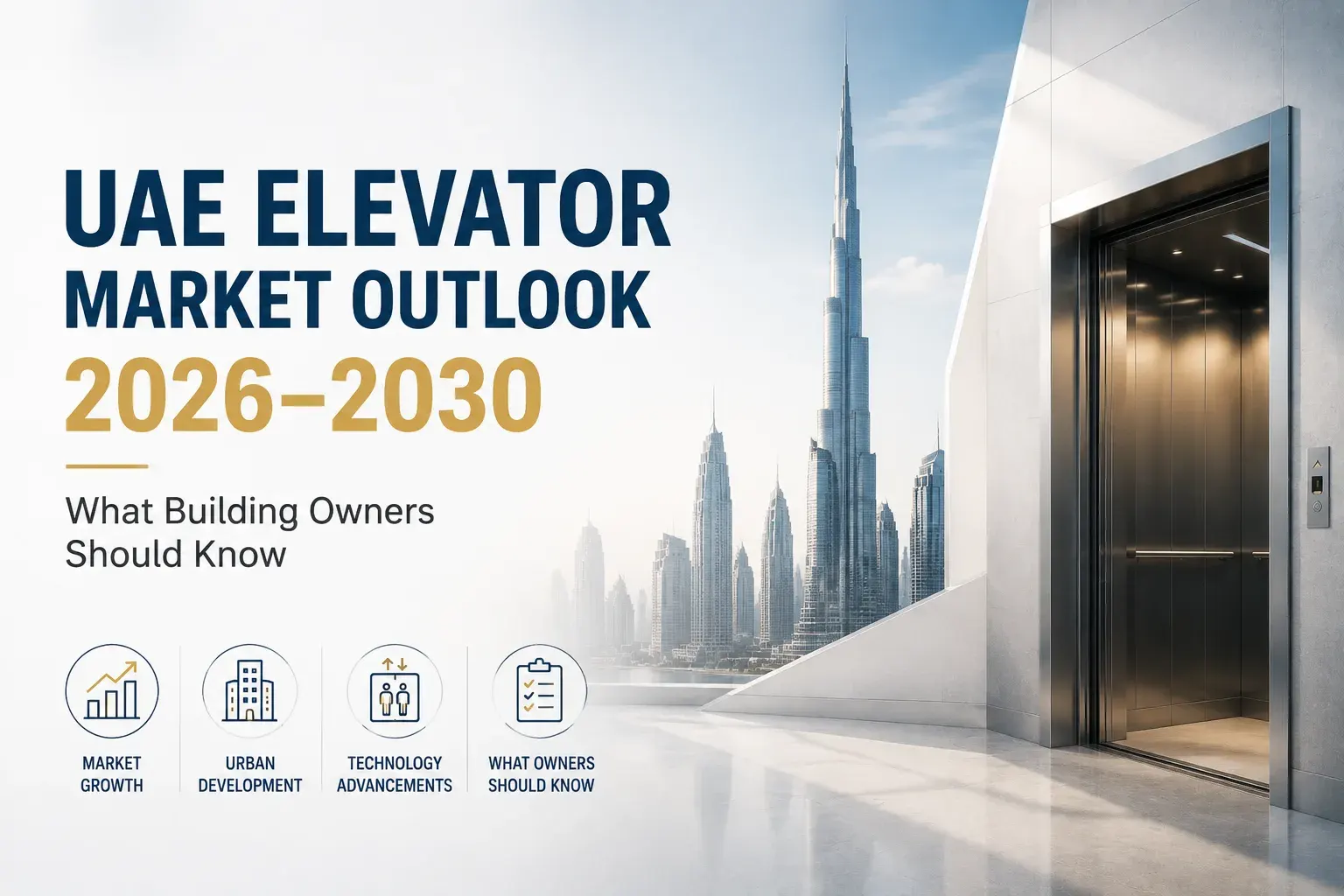

Dubai’s skyline kept growing through 2026, and the elevator industry that keeps it moving grew with it. New supertall towers, a rising number of buildings old enough to need modernization, and a 2026 building-safety law that brought elevator compliance under one national framework are all part of the UAE elevator market trends 2026 story. Research firms report different growth numbers because each one measures a different part of the market. This guide lays out where the market is headed through 2030, what is driving it, and what it means for anyone who owns or manages a building in the UAE.
Table of Contents
- How Did the UAE Elevator Market Reach This Point?
- What Are the Key UAE Elevator Market Trends in 2026?
- What Is the UAE Elevator Market Size and Growth Forecast Through 2030?
- What Factors Are Driving UAE Elevator Market Growth?
- What Challenges Does the UAE Elevator Market Face?
- Which Technologies Are Shaping the UAE Elevator Market?
- What Will the UAE Elevator Market Look Like by 2030?
- What Should Building Owners Do About These Trends?
- From the Field
- Key Takeaways
How Did the UAE Elevator Market Reach This Point?
Dense high-rise living across Dubai and Abu Dhabi turned vertical transportation into core infrastructure.
- York Lift, founded in 2006, has served the elevator industry UAE-wide for two decades, alongside global manufacturers such as Otis, KONE, Schindler, Mitsubishi Electric, and TK Elevator.
- Early growth centered on new installations; today’s demand centers on keeping existing units safe and compliant.
- Free-zone and logistics construction across Dubai, Sharjah, and Abu Dhabi added a new source of industrial demand.
What Are the Key UAE Elevator Market Trends in 2026?
Here are the four shifts behind UAE elevator market trends 2026 that developers and facility managers should watch.
- Smart, connected elevators become the default – IoT monitoring, once a premium add-on, now appears in most new commercial installations and modernization proposals.
- Modernization overtakes new installations – a large share of Dubai’s buildings are now 15–20 years old; TechSci Research projects modernization growing at ~5.92% CAGR through 2029, faster than new installations.
- Sustainability becomes a procurement requirement – developers now specify regenerative drives and standby power as a baseline, tied to Net Zero 2050.
- Regulatory compliance drives demand – the 2026 building-safety law ties elevator certification to a building’s overall safety status.
What Is the UAE Elevator Market Size and Growth Forecast Through 2030?
Market-size figures disagree because each research firm tracks a different measure: new units, total market value, or installed base.
| Metric | Figure | Source | What it measures |
| New installation units | ~16,150 (2024) → ~19,100 (2030) | Arizton Advisory & Intelligence | New installations only |
| Installed base by 2030 | ~124,000 units | Arizton Advisory & Intelligence | Cumulative elevators in operation |
| Commercial segment share | ~65% (2025) | MarkNtel Advisors | Share by end-user category |
| UAE CAGR | ~3.97% (2026–2032) | MarkNtel Advisors | Broad market forecast |
| UAE CAGR | ~5.92% (through 2029) | TechSci Research | Modernization as fastest-growing segment |
| UAE CAGR | ~7.2% (2024–2029) | Bonafide Research | Different scope/baseline year |
| Global CAGR (context only) | ~4.6% (2025-2033) | IMARC Group | Global, not UAE-specific |
| UAE FDI target | $65.35B/year by 2031 | UAE National Investment Strategy 2031 | Indirect demand driver |
The clearest elevator installation forecast comes from Arizton: roughly 16,150 new installations in 2024, rising to ~19,100 by 2030. NextMSC Research (Feb 2026) separately values the market at USD 689.1 million in 2025, growing to USD 883.1 million by 2030 at 5.1% CAGR – a market-value figure, not a unit count, so it complements rather than contradicts Arizton’s numbers.
- Commercial buildings hold the largest share today; residential demand – led by villas – is the fastest-growing; industrial volume is smaller but rising.
- Dubai leads lift market Dubai activity, driven by its concentration of pre-2010 towers; Abu Dhabi shows steady government-linked demand; the Northern Emirates show smaller but rising activity.
What Factors Are Driving UAE Elevator Market Growth?
- Construction pipeline – supertall towers and the Dubai 2040 Urban Master Plan keep adding demand across the vertical transportation market.
- Government policy – Net Zero 2050, Vision 2031, and the National Investment Strategy 2031 convert sustainability targets into direct elevator demand.
- Aging building stock – pre-2010 towers increasingly qualify for modernization rather than routine repair, fueling elevator modernization demand.
- Tourism and hospitality expansion – continued hotel development adds to demand, supporting broader UAE construction sector growth.
What Challenges Does the UAE Elevator Market Face?
- Technician talent gap – demand for IoT-trained technicians is outpacing the current talent pool.
- Rising compliance costs – the 2026 safety law adds certification steps on top of standard AMC fees.
- Inconsistent market data – Arizton, MarkNtel, TechSci, and Bonafide each measure a different slice of the market.
- Gulf climate conditions – heat, humidity, and dust shorten component lifespan and raise maintenance frequency.
- Spare-parts lead time – discontinued models can face longer waits for replacement parts, pushing owners toward modernization.
Which Technologies Are Shaping the UAE Elevator Market?
- IoT and predictive maintenance – sensors flag component wear ahead of failure; see York Lift’s elevator maintenance services
- Machine-Room-Less (MRL) systems – free up floor space where a traditional machine room is impractical.
- Destination dispatch – groups passengers by floor before boarding, cutting wait times in high-traffic towers.
- Regenerative drives – recover energy during braking and descent, supporting smart elevator adoption UAE-wide.
What Will the UAE Elevator Market Look Like by 2030?
- A service-led market – as installation growth levels off, maintenance and modernization contracts become the steadier revenue base.
- Concentrated investment – spending focuses on retrofit-ready smart systems and compliance-driven upgrades for pre-2010 towers.
- A widening service gap – providers combining global-brand parts sourcing with local response times gain more AMC contracts.
What Should Building Owners Do About These Trends?
- Budget early – schedule a condition assessment once a building passes the 10–15 year mark.
- Ask the right questions – confirm how a vendor handles predictive-maintenance monitoring and 2026 compliance.
- Verify smart-elevator claims – request concrete sensor types, reporting frequency, and named client results.
Key Takeaways
- Modernization and maintenance lead UAE elevator market trends 2026 growth, ahead of new installations.
- Commercial buildings hold the largest demand share today; residential is catching up quickly.
- IoT-enabled predictive maintenance is moving from a premium add-on to a market expectation.
- Dubai’s 2026 building-safety law folds elevator compliance into a building-wide safety certificate.
- Market-size figures vary by source – confirm whether a number measures new units, market value, or installed base.
- Net Zero 2050, Vision 2031, and the Dubai 2040 Master Plan act as direct demand drivers for the elevator industry UAE.
Conclusion: What This Means for UAE Building Owners
The UAE elevator market trends 2026 point to a market that keeps expanding while decisions for building owners get more complex. Modernization now grows faster than new installations, smart and predictive-maintenance-ready elevators shift from optional to expected, and compliance ties directly to a building’s safety certificate. Owners managing pre-2010 towers, or specifying elevators for new developments, benefit from budgeting for elevator modernization ahead of time.
Related reading: Why Elevator Modernization is a Must for Dubai’s Older Buildings · Top Elevator Technology Trends Shaping UAE Infrastructure Projects